Prompt Caching Explained: How to Cut LLM Cost by up to 90% Without Losing Quality
Prompt caching reuses precomputed KV state for identical prompt prefixes, cutting cost up to 90% and latency up to 85% with no quality change.
Contents
Short answer: Prompt caching stores the model's precomputed attention state (the KV matrices) for a prompt prefix so it never has to recompute those tokens on the next request. Reusing that state is dramatically cheaper and faster: Anthropic reports cost cuts of up to 90% and latency cuts of up to 85%, with cache reads billed at $0.30/M tokens versus $3.00/M for fresh input. The output is identical to an uncached run.
What prompt caching actually is
When an LLM processes your prompt, it computes a key/value (KV) matrix for every token in the attention layers. That prefill step is the expensive part. Prompt caching keeps those KV matrices around after a request, so if your next request starts with the exact same prefix, the provider skips prefill for those tokens and jumps straight to generating.
Crucially, it is a compute shortcut, not a different model. Same weights, same sampling, same result. You only save money and time on the tokens you reused.
How the three big providers differ
| Provider | How it's enabled | Read discount | Cache lifetime |
|---|---|---|---|
| Anthropic | Explicit cache_control markers on blocks | ~90% (reads $0.30/M vs $3.00/M fresh on comparable tiers) | ~5 min, refreshed on use |
| OpenAI | Automatic, no code change | ~50% off cached input | Minutes of inactivity (~5–10) |
| Google (Gemini) | Implicit (automatic) + explicit context caching API | Discounted cached tokens | Configurable TTL (explicit) or short window (implicit) |
The key contrast: OpenAI caches automatically and gives you a 50% discount with zero code changes, while Anthropic requires you to mark cacheable blocks with cache_control but rewards that effort with a much steeper discount. Across providers the KV matrices are typically held for roughly 5–10 minutes after a request (as documented by PromptHub and ngrok), so caching pays off for bursty, repeated traffic, not one-off calls hours apart.
Design your prompt for cache hits
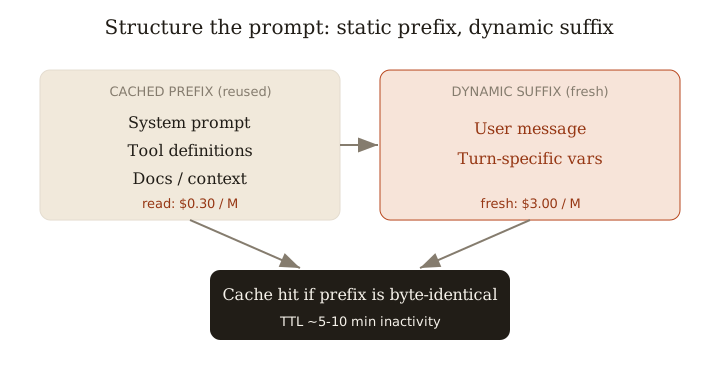
The rule is simple: static content first, variable content last. A cache hit requires the prefix to be byte-for-byte identical, so anything that changes per request must come after everything you want cached.
- Put the system prompt, tool/function definitions, and long reference docs at the very top.
- Put the user's turn, timestamps, retrieved snippets that change, and IDs at the bottom.
- On Anthropic, place
cache_controlat the end of the last static block so everything above it is cached.
# Anthropic: cache the big static prefix, vary only the user turn
messages = [{
    "role": "user",
    "content": [
        {"type": "text", "text": SYSTEM_DOCS,          # static, huge
         "cache_control": {"type": "ephemeral"}},       # cache up to here
        {"type": "text", "text": user_question},        # dynamic, cheap
    ],
}]
Pitfalls that quietly kill your savings
Any prefix change invalidates the cache. Injecting the current time, a random request ID, or reordering tool definitions at the top of the prompt means a full recompute every time. Move all of it below the cached boundary.
Agentic loops break the cache in a subtle way. Each tool call appends a result to the conversation, which changes the suffix but not the prefix, so the original static prefix still hits. The trap is mutating earlier messages, re-summarizing history in place, or re-ordering tool outputs, which shifts the prefix and forces recomputation on every loop iteration. Append-only conversation history is what keeps long agent runs cheap.
The TTL is short. With a ~5–10 minute window, low-traffic endpoints may never see a second hit before the entry expires. Caching helps most under sustained or bursty load; measure your hit rate before assuming the discount.
You still pay to write the cache. On Anthropic, the initial cache write costs more than a normal token (roughly 1.25x), so caching a prefix used only once is a net loss. It wins when the same prefix is reused many times.
Cutting cost up to 90% comes down to one discipline: keep a large, stable prefix and append everything that varies — never edit what came before.
Related: more writing.
Frequently asked
- Does prompt caching change the model's output?
- No. It reuses precomputed attention state for an identical prefix, so outputs are the same, just cheaper and faster.
- How much does prompt caching actually save?
- Up to ~90% on Anthropic (cache reads at $0.30/M vs $3.00/M fresh) and about 50% automatically on OpenAI, plus up to 85% lower latency.
- How long does a cache entry last?
- Typically 5–10 minutes of inactivity for most providers, after which the prefix must be recomputed. Anthropic's window refreshes on each use.
- What breaks a cache hit?
- Any change to the cached prefix — a new timestamp, request ID, or reordered tools. Keep static content first and put variable content last.
Keep reading
Get new essays by email
Occasional field notes on production RAG and LLM systems. No spam, unsubscribe anytime.