Why I don't use LangChain in production RAG
Frameworks are great for a demo. In production, the abstraction you can't see into costs more than it saves.
Contents
The standard advice is "start with LangChain, it's the default." And for a weekend prototype, that's fine — it gets you from zero to a working demo fast.
But the moment a RAG system has to run in production — real users, real data, real 2am pages — I've consistently found the abstraction costs more than it saves. So my production pipelines don't use it. Here's the reasoning.
The problem isn't LangChain. It's opacity.
A retrieval-augmented pipeline is, underneath, a very small number of steps: embed the query, search the vector store, assemble a prompt, call the model. The hard part isn't wiring those together — it's knowing exactly what happened when the output is wrong.
That's precisely what a heavy framework takes away from you.
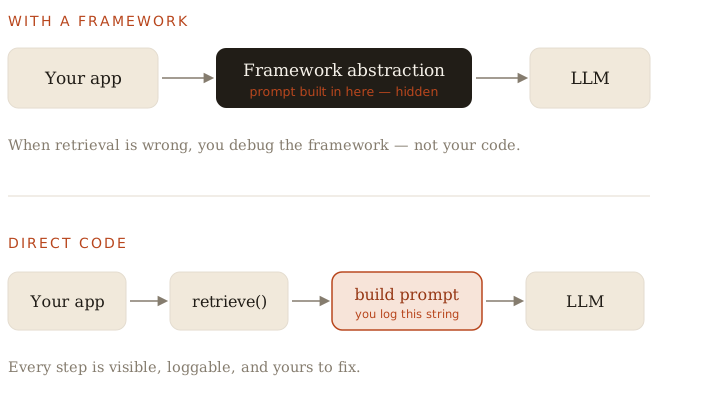
When retrieval returns garbage, I want to answer three questions in seconds: what did the retriever actually return, what prompt did the model actually receive, and where did it diverge from what I expected? Inside a framework, the prompt is assembled somewhere I can't easily see, behind helpers and callbacks. So debugging becomes archaeology through someone else's abstraction instead of reading my own code.
What "direct" actually looks like
The whole retrieval-to-answer path, in plain sight:
# Embed → search → assemble → call. Nothing hidden.
query_vec = embed(query)                       # my embedding call
hits = store.search(query_vec, limit=8, filters=filters)
context = "\n\n".join(h.text for h in hits)

prompt = f"{SYSTEM}\n\nContext:\n{context}\n\nQuestion: {query}"
answer = llm.chat(prompt)   # I can log this exact string. That's the point.
It's more lines than a framework one-liner. That's a feature. Every line is one I can read, log, test, and change without guessing what a wrapper does under it.
The three things I stopped losing
- Visibility into the prompt. The single most useful log line in any RAG system is the final assembled prompt. When I own the assembly, I own that log.
- Debuggability. A bad answer traces to my code, not to a version of a dependency that quietly changed behaviour on upgrade.
- Control over cost and latency. Nothing runs that I didn't write. No surprise extra model calls, no hidden retries.
To be fair
LangChain is genuinely useful for what it's good at: prototyping, learning the moving parts, and exploring ideas quickly. If you're figuring out whether an idea works at all, reach for it.
The mistake isn't using a framework. The mistake is carrying that abstraction into production and hoping it holds when the abstraction is the exact thing standing between you and a fix.
For production RAG, I'll take boring, transparent code over a framework I can't see into — every time.
If you run RAG in production: are you still on a framework, or did you also end up dropping to raw code? I'm genuinely curious where people landed.
Keep reading
Get new essays by email
Occasional field notes on production RAG and LLM systems. No spam, unsubscribe anytime.