From Cloud Qdrant RAG to On-Device RAG: What Actually Transfers and What Doesn't
Moving a production cloud RAG pipeline on-device: the shape transfers, but index scale, embedder size, and re-ranking budgets do not.
Contents
Short answer: The pipeline shape transfers cleanly — you still chunk, embed, do ANN retrieval, and generate. What does not transfer is scale and slack: your index size is capped by unified memory plus disk instead of a shardable cluster, your embedder shrinks to something that fits and runs locally (costing recall), and the cheap hosted re-ranker call disappears, leaving the context window as your hard budget.
I ran a Qdrant-backed search pipeline in production — vector similarity plus payload pre-filters, hydrate from Postgres, post-sort. Here is what I learned porting that mental model to a fully on-device design.
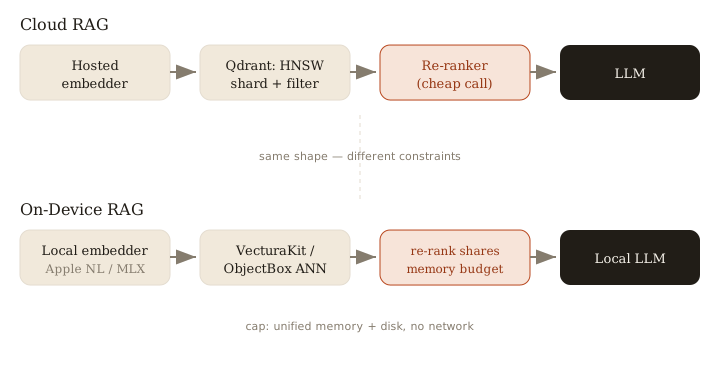
The shape transfers, the budgets don't
Chunk → embed → retrieve → rerank → generate survives the move. The four things that break are index scale (no cloud sharding), embedder size (must fit locally), the re-ranking budget (no free hosted call), and the fact that on-device removes network round-trips but caps index size at unified-memory and disk realities. Everything below is a consequence of those four.
Embeddings: the swap that quietly costs recall
Hosted models like text-embedding-3-small give you 512–1536 dims with strong quality and zero local footprint. On-device, you pick from a spectrum: Apple's zero-dependency Natural Language embeddings at one end, MLX or ModernBERT-class models at the other. VecturaKit exposes exactly this range, and the tradeoff is real — smaller local embedders lose recall, especially on paraphrase and multi-hop queries.
Two things that bit me:
- Dimension mismatch. You cannot reuse a cloud-built index with a new embedder. Different model, different vector space — you re-embed the entire corpus.
- Recall regression is silent. The pipeline still returns results; they're just worse. Build a small labeled query set and measure recall@k before and after the swap. Do not eyeball it.
Vector store: Qdrant features you'll miss
Qdrant gives you HNSW with rich payload filtering, multi-value MatchAny filters, and horizontal sharding. On-device stores like VecturaKit and ObjectBox provide genuine local ANN — fast and good for thousands to a few million vectors — but not Qdrant-scale sharding or heavily-filtered indexes.
Practical consequences:
- Complex pre-filtering (the payload
MatchValue/MatchAnycombinations you lean on in Qdrant) is thinner or absent. Expect to filter in application code after ANN, which means over-fetching candidates. - There is no sharding escape hatch. When the index outgrows memory, you either quantize, prune, or move to online/streaming indexing. EdgeRAG and MobileRAG (arXiv 2412.21023, 2507.01079) do exactly this — build indexes online to stay inside device memory and energy budgets rather than holding everything resident.
Retrieval budget: no free re-ranker, context is the wall
In the cloud, a re-rank call is a rounding error — fire off 100 candidates to a hosted cross-encoder and keep the top 10. On-device that call competes for the same memory and compute as your generator. Re-ranking is still possible, but it is no longer free.
So the discipline inverts. Instead of "retrieve wide, rerank hard," you retrieve a small, high-precision candidate set and spend the context window carefully — because the context window, not an external ranking service, is now the hard constraint. Keep candidate sets small (single-digit to low-tens), and if you rerank, use a tiny model and cap the batch.
Cloud:      ANN(top 200) → hosted rerank(200→10) → LLM
On-device:  ANN(top 20)  → optional local rerank(20→6, shared budget) → local LLM
Migration checklist
- Benchmark recall first. Labeled query set, recall@k with the cloud embedder as baseline. This is your regression gate.
- Pick the embedder against the budget. Apple NL if quality allows; MLX/ModernBERT-class if you need it and can afford the load time and memory.
- Re-embed everything. New model = new vector space = full rebuild.
- Move filters into app code. Assume Qdrant-style payload filtering won't fully port; over-fetch then filter.
- Size the index to memory. If it doesn't fit, choose quantization, pruning, or online indexing (EdgeRAG/MobileRAG) — decide before shipping, not after OOM.
- Shrink the retrieval budget. Small candidate sets, optional tiny reranker, context window as the governing constraint.
- Delete network assumptions. No round-trips is a latency win; no elastic scale is the cost.
Bottom line: on-device RAG is your cloud pipeline with the slack removed — the algorithm survives, the abundance doesn't.
Related: more writing.
Frequently asked
- Does my RAG code transfer to on-device?
- The chunk-embed-retrieve-generate shape does. What changes is index scale, embedder size, and the loss of cheap re-ranking.
- Can on-device match Qdrant at scale?
- No. On-device ANN (VecturaKit, ObjectBox) handles thousands to a few million vectors well, but not sharded, heavily-filtered cloud-scale indexes.
- What hurts recall most on-device?
- Dropping to a smaller local embedding model. It costs recall silently — measure recall@k before and after the swap against a labeled query set.
- Is re-ranking possible on-device?
- Yes, but it competes for the same memory and compute as the generator, so keep candidate sets small and use a tiny reranker if any.
Keep reading
Get new essays by email
Occasional field notes on production RAG and LLM systems. No spam, unsubscribe anytime.