Why Dense Retrieval Fails on Acronyms, IDs, and Code (and How Hybrid Fixes It)
Vector search misses exact terms like SKUs and error codes because embeddings blur rare tokens; a sparse channel restores exact-match signal.
Contents
Short answer: Vector search misses exact terms like product codes and acronyms because embedding models compress every token into a shared semantic space, and rare strings have too little training signal to keep a distinct location. So E4021 lands somewhere near "error-ish" and SKU-8842 near "product-ish" — close to lots of things, exactly equal to nothing. A sparse/lexical channel keeps the literal token, which is why hybrid retrieval fixes the problem.
What actually goes wrong inside the embedding
Dense embeddings are trained to put semantically similar text near each other. That objective is great for "affordable Italian near me" matching "cheap pasta place." It is actively harmful for identifiers.
A rare token like a SKU, an error code, or a private function name shows up a handful of times (or zero) in the model's training data. With no strong signal, the model smears it into the semantic neighborhood of its surrounding tokens. The exact-match signal — the thing you actually care about — gets averaged away. Two different SKUs that share a prefix can end up nearly identical vectors.
This is the core finding echoed across 2026 practitioner guides: dense RAG fails on rare terms, and hybrid search is the standard fix.
Concrete failure cases from production
These are the query shapes where I've watched pure dense retrieval quietly return plausible-but-wrong results:
- SKUs / product codes:
SKU-8842retrieves other SKUs with similar structure, not the exact item. - Error codes:
E4021matches generic "error" and "failure" docs; the one page documenting E4021 ranks below them. - Function / symbol names:
hydrate_restaurant_filterspulls back semantically related code (other hydrators) instead of the exact definition. - Acronyms:
RRFmatches "ranking fusion" prose but can miss the doc that literally defines RRF, especially when the acronym collides across domains. - Version strings & config keys:
v2.3.1,QDRANT_TIMEOUT_MS— high exact-match intent, near-zero semantic content.
The tell is always the same: the user typed a string they expect to find verbatim, and dense retrieval treated it as a vibe.
Why sparse retrieval nails these and dense doesn't
Sparse/lexical methods (BM25, and newer learned-sparse variants like BM42 and miniCOIL) represent text as token-level term weights. E4021 is its own dimension. If the query token appears in the document, that dimension fires; if it doesn't, it doesn't. There is no smearing — exactness is the whole model.
The flip side: sparse retrieval is brittle on paraphrase. "car" won't match "automobile," and a query with no shared tokens scores zero. Dense handles that easily. Neither channel is strictly better — they fail on different queries. That asymmetry is exactly why learned-sparse models like BM42 and miniCOIL exist: to recover cases that dense-only and classic sparse-only each miss.
The hybrid fix and how to weight it
Run both channels, then fuse. The two common fusion methods:
- RRF (reciprocal rank fusion): rank-based, no score calibration needed. Safe default.
- Weighted score fusion: normalize each channel's scores, then blend with a weight
alpha.
Across benchmarks and practitioner reports, hybrid improves retrieval accuracy roughly 8-15% over pure dense, and that lift is concentrated almost entirely on exact-term queries — the SKUs, codes, and acronyms above.
For keyword-heavy domains (code search, support tickets, catalogs, logs), push weight toward the lexical channel:
# weighted hybrid: alpha = dense weight, (1 - alpha) = sparse weight
def hybrid_score(dense, sparse, alpha=0.5):
    d = normalize(dense)     # min-max per query
    s = normalize(sparse)
    return alpha * d + (1 - alpha) * s

# keyword-heavy corpus? drop alpha so sparse dominates
score = hybrid_score(dense_hits, sparse_hits, alpha=0.35)
Start at alpha=0.5, then tune down for identifier-heavy corpora. I've landed around 0.3-0.4 for anything code- or SKU-shaped.
Diagnosing which queries need the lexical channel
You don't need hybrid on every query, but it costs little to always run it. To decide where it matters, profile your query log:
- Flag queries containing tokens that are rare in your corpus vocabulary (low document frequency).
- Flag queries matching patterns: uppercase runs, digits mixed with letters, underscores/dots, version-like strings.
- A/B the two channels offline on a labeled set and bucket wins by query type — the lexical wins will cluster on exactly these shapes.
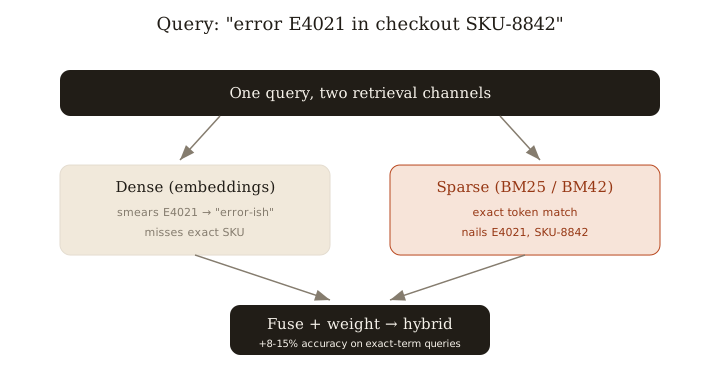
If your users type strings they expect to find verbatim, you need a sparse channel — dense alone will average their intent into noise.
Related: more writing.
Frequently asked
- Why does vector search miss exact matches?
- Embeddings map rare tokens into a fuzzy semantic space, so exact strings like codes lose their distinctiveness and match many things approximately instead of one thing exactly.
- What retrieval catches exact terms?
- Sparse/lexical retrieval (BM25, BM42, miniCOIL) preserves exact-token signal that dense embeddings blur, giving each token its own dimension.
- How do I fix it?
- Add a sparse channel and fuse results (hybrid). For keyword-heavy domains like code or catalogs, weight the lexical channel higher (alpha around 0.3-0.4).
- How much does hybrid actually help?
- Hybrid typically improves retrieval accuracy 8-15% over pure dense, with the gain concentrated almost entirely on exact-term queries like SKUs, error codes, and acronyms.
Keep reading
Get new essays by email
Occasional field notes on production RAG and LLM systems. No spam, unsubscribe anytime.