Corrective RAG (CRAG) Explained: Self-Healing Retrieval Without Fine-Tuning
Corrective RAG inserts a retrieval evaluator between vector search and the LLM that scores documents and routes to proceed, filter, or re-retrieve.
Contents
Short answer: Corrective RAG (CRAG) is a retrieval pattern that inserts a lightweight retrieval evaluator between your vector search and your LLM. The evaluator scores how relevant the retrieved documents actually are, then routes the request down one of three paths: proceed with good docs, filter and refine ambiguous ones, or fall back to an alternative source (like web search) when retrieval fails. It self-corrects bad retrievals before they reach the model, and it needs no fine-tuning.
What CRAG actually adds
Vanilla RAG blindly trusts whatever the retriever returns. If your top-k chunks are off-topic, the LLM either hallucinates or confidently answers from garbage. CRAG closes that gap by adding one evaluation step that classifies retrieved documents as Correct, Incorrect, or Ambiguous, and adjusts strategy accordingly (a framing echoed by Meilisearch and kore.ai).
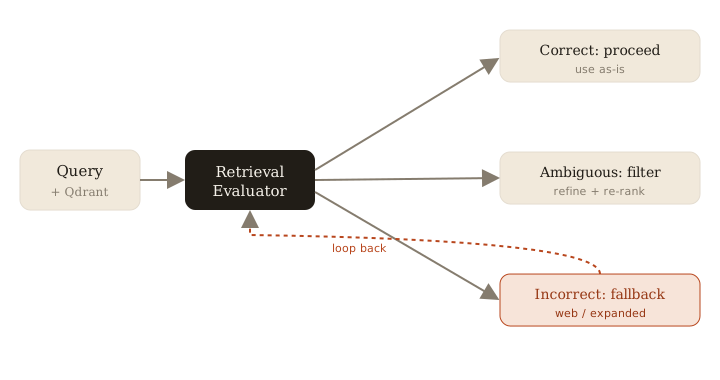
The three actions
- Correct (proceed): Confidence is high. Pass the documents to the LLM as-is, optionally after a light knowledge-refinement/strip step.
- Ambiguous (filter + refine): The signal is mixed. Keep the strong chunks, drop the weak ones, and rewrite the query to sharpen the next retrieval. This is where CRAG earns most of its accuracy gains in practice.
- Incorrect (fall back): Nothing relevant came back. Trigger an alternative retrieval path — web search, an expanded index, or relaxed filters — rather than answering from a bad context.
The routing threshold is yours to tune. A common setup: two confidence cutoffs producing three bands.
Where the evaluator lives and how to score cheaply
The evaluator sits after retrieval and before generation. You have three practical options, cheapest first:
- Score reuse: Start from the retriever's own similarity scores. Free, but noisy — cosine distance is not relevance.
- Cross-encoder / reranker: A small reranker (e.g. a bge-reranker class model) gives a real relevance score per (query, doc) pair for a few milliseconds each.
- LLM judge: A tiny grader prompt ("is this document relevant to the query? yes/no + score") on a small, fast model. Flexible, but the most expensive option.
Keep the grader cheap. CRAG adds one evaluation per retrieval, and if you grade with your main model you can double response time and cost for no reason.
Why it fits closed APIs
The original Self-RAG line of work trains the model to emit reflection tokens — that means fine-tuning, which you can't do on GPT-4o or Claude. CRAG puts all the correction logic outside the model, so it works with closed models with no fine-tuning at all (customgpt.ai makes this point directly). A useful way to hold the distinction: CRAG improves the quality of the evidence; Self-RAG improves the model's reasoning over evidence (a comparison from elegant software solutions). If you're on a hosted API, CRAG is the pattern you can actually ship.
A minimal CRAG loop over Qdrant
async def crag_answer(query: str, k: int = 5) -> str:
    docs = await qdrant_search(query, k=k)          # vector retrieval
    graded = [(d, await grade(query, d)) for d in docs]  # small reranker/judge

    strong = [d for d, s in graded if s >= 0.7]     # Correct band
    weak   = [d for d, s in graded if 0.3 <= s < 0.7]  # Ambiguous band

    if strong:                                       # Correct: proceed
        context = strong
    elif weak:                                       # Ambiguous: filter + refine
        refined = await rewrite_query(query)
        context = weak + await qdrant_search(refined, k=k)
    else:                                            # Incorrect: fall back
        context = await web_search(query)

    return await llm.generate(query, context)        # closed API, no fine-tuning
grade() is the only new dependency, and it's swappable — reranker today, LLM judge tomorrow — without touching the loop. Log the verdicts; the distribution of Correct/Ambiguous/Incorrect over real traffic tells you whether your index or your threshold needs work.
Takeaway: CRAG is the cheapest reliable way to stop a hosted LLM from answering off bad retrievals — one grader, three routes, zero fine-tuning.
Related: more writing.
Frequently asked
- Does CRAG require fine-tuning?
- No. The evaluator can be a similarity score, a small reranker, or an LLM judge, so CRAG works with closed APIs like GPT-4o and Claude.
- What are CRAG's three document verdicts?
- Correct (use as-is), Ambiguous (filter the weak chunks and refine the query), and Incorrect (trigger alternative retrieval such as web or expanded search).
- How much latency does CRAG add?
- One evaluation step per retrieval. Keep it cheap with a small reranker or grader model so you don't double response time by grading with your main LLM.
- How is CRAG different from Self-RAG?
- CRAG improves the quality of the retrieved evidence with an external evaluator; Self-RAG improves the model's reasoning over evidence via trained reflection tokens, which needs fine-tuning.
- Is CRAG the same as agentic RAG?
- No. CRAG is a corrective pattern focused on fixing bad retrievals, and it is often used as one component inside a broader agentic RAG system.
Keep reading
Get new essays by email
Occasional field notes on production RAG and LLM systems. No spam, unsubscribe anytime.